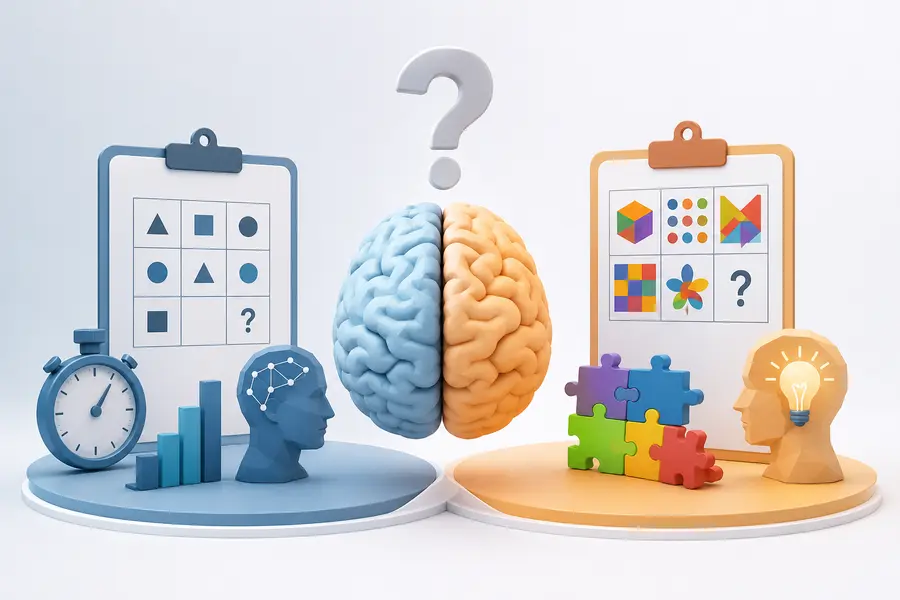
We often use the terms intelligence test and IQ test interchangeably, and online they are frequently swapped. But are they really the same, or is there a technical difference? In everyday language they mean largely the same thing, but in psychology, an intelligence test is a broader umbrella term. An IQ test is the most well-known type of measurement under this umbrella. Let's look closer at where the differences begin.
What is an intelligence test?
An intelligence test is a general term for tools that measure cognitive abilities using a standardized method. A good intelligence test evaluates reasoning ability rather than memorized knowledge: skills like pattern recognition, logical reasoning, verbal and numerical problem-solving, visual-spatial thinking, working memory, and processing speed. It does not ask about history, geography, or general trivia; it evaluates your capacity to solve a problem you encounter for the first time.
Behind these skills lies a common core that psychologists call "general intelligence" or the g factor. What intelligence actually is and how many types exist is a topic on its own; if you are curious, our article What Is Intelligence? Types and Measurement is a good start. Different tests measure this core through various sub-skills; to see what kinds of questions appear on a test, read our guide Types of Questions on an IQ Test.
What is an IQ test?
IQ stands for "Intelligence Quotient." An IQ test is also an intelligence test; what sets it apart is that it converts your result into a standard IQ score. In modern tests, this score is scaled so that the mean is 100 and the standard deviation is 15. A score of 100 represents the average, showing where you stand relative to people in your age group.
There is an interesting historical detail: the word "quotient" once came from an actual division calculation. In the older method, IQ was calculated using the formula "mental age / chronological age x 100" (ratio IQ). However, this formula broke down for adults. In 1939, David Wechsler introduced the deviation IQ approach used today: your score is determined by how much you deviate from the average of your age group rather than by division. You can learn what scores mean and view a levels chart in our article What Should an IQ Score Be?, and read why the average is 100 in our post What Is the Average IQ?.
So, are they the same or different?
The bottom line is this: every IQ test is an intelligence test, but not every intelligence test gives a classic IQ score. "Intelligence test" is an umbrella term, while an "IQ test" is a specific type that expresses the result as a single standard score. In everyday conversation, this distinction is often minor, and both terms are used interchangeably. Here is a quick comparison:
| Intelligence Test | IQ Test |
|---|---|
| General/umbrella concept | A specific type of intelligence test |
| Can measure different skills separately | Converts results into a single IQ score |
| May not always provide a single score | Provides a standard score with a mean of 100 and standard deviation of 15 |
| e.g. tests measuring attention, memory, or aptitude | e.g. Wechsler (WAIS/WISC), Stanford-Binet |
Another concept that is frequently confused is emotional intelligence. We explained why IQ and EQ are different in our article What Is EQ? Differences Between IQ and EQ.
The real distinction: clinical test or online test?
In reality, what confuses most people is not the distinction between "intelligence" or "IQ," but how the test is administered. There are two distinct categories here:
- Individual (clinical) intelligence test: Administered one-on-one by a qualified psychologist in a controlled setting. Examples include Wechsler scales like WISC and WAIS, Stanford-Binet, or ASIS developed in Turkey. The result can form an official report used for diagnosis, gifted education applications, or educational guidance. We explained where and by whom this test is performed in our article Which Hospital Department Administers Intelligence Tests?, and covered the process for children in Measuring Intelligence in Children.
- Online intelligence/IQ test: Taken independently in just a few minutes. Its goal is not to diagnose, but to offer a quick and engaging estimate of your cognitive abilities. If you want to learn about the most common test types (WAIS, Stanford-Binet, Raven), check out our post on Types of IQ Tests.
How reliable is an online intelligence test?
When well-designed, online tests provide a reasonable idea of your cognitive performance, but they do not replace an official clinical evaluation. What makes an online test reliable is question quality, consistency of results, and grounded interpretation of scores. We explored this topic in detail in Are IQ Tests Reliable?. In short: view online tests as a starting point and mental exercise, and read your score as a snapshot of your performance that day rather than your entire identity.
If you are curious, checking your own score is the easiest way to start. You can take our free IQ test without signing up. If you want to challenge your mind further, explore our brain games to build your attention, memory, and logic skills day by day.