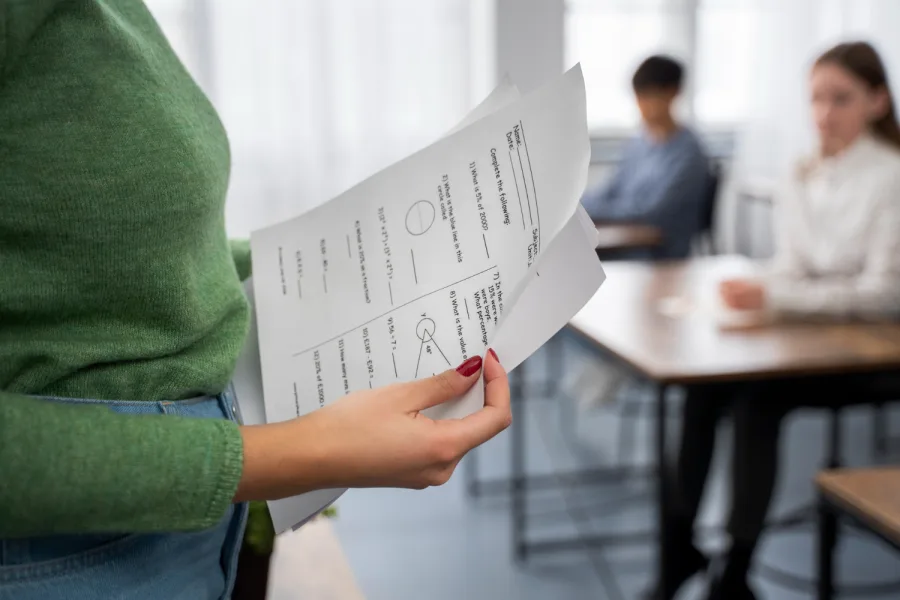
WISC-R test items are restricted materials. They aren't freely sold or published, and nearly all online content titled "WISC-R questions" is either made up or compiled from other tests.
This article won't give you the real questions—it can't. But it gives you what you're likely looking for: what types of skills the subtests measure, why test prep backfires, and what you can actually do.
Why questions aren't published
1. A published item is an invalid item
This is the main reason and the easiest to understand.
An intelligence test item is designed assuming the child has never seen it before. It measures how the child handles an unfamiliar problem.
The moment an item is published, that assumption breaks. A child who memorized the answer uses memory instead of reasoning. The test can't tell the difference.
Publishing even a single item makes it useless for all children. Developing new items requires years of norming studies.
2. Copyright and access restrictions
These tests are copyrighted materials, and distribution is limited to authorized institutions. Materials are provided only to trained practitioners.
3. Professional ethics
Protecting test security is a core standard of professional psychology ethics. Practitioners are obligated not to share test items.
What skills the subtests measure
I can't share the real test items, but I can explain what each subtest asks for. This isn't for test prep, but to help you understand the process.
Verbal section
| Subtest | Task required | What it measures |
|---|---|---|
| Information | Answering brief factual questions | Acquired knowledge, cultural exposure |
| Similarities | Explaining what two concepts have in common | Abstract categorization |
| Arithmetic | Solving word problems mentally | Numerical reasoning + working memory |
| Vocabulary | Defining words | Language development, conceptual depth |
| Comprehension | Explaining what to do in everyday situations | Social reasoning, practical judgment |
| Digit Span | Repeating digits forward and backward | Working memory |
Performance section
| Subtest | Task required | What it measures |
|---|---|---|
| Picture Completion | Finding missing parts in pictures | Visual attention, essential detail recognition |
| Picture Arrangement | Ordering cards to tell a story | Cause-and-effect, social context |
| Block Design | Recreating patterns using blocks | Visuospatial reasoning |
| Object Assembly | Putting puzzle pieces together | Part-to-whole relationships |
| Coding | Quickly matching symbols to numbers | Processing speed |
| Mazes | Drawing a path out of a maze | Planning ability |
To learn more about the overall structure and scoring logic, check out our article on what the WISC-R test is.
Why test prep backfires
This is the part that parents searching for questions really need to read.
Scores go up, but tell you nothing
Intensive prep might raise the score slightly. But what increases isn't the child's underlying ability—it's just performance on that specific format.
The result is a score that doesn't reflect your child's true profile. Yet decisions will be made based on that number.
Real needs get masked
This is the biggest risk. Testing is usually requested because of a concern: school struggles, attention issues, or suspected learning differences.
An artificially inflated score can prevent a child from getting the support they genuinely need. A "good result" ends up working against them.
The profile gets distorted
In clinical practice, key insights come from differences between subtest scores, not just the total IQ. Prepping for some subtests skews this profile and invalidates the interpretation.
The aftermath of placement
A child who enters a gifted program by cramming may struggle to keep up with a fast-paced curriculum. A short-term gain creates a long-term burden.
What you can actually do
There are legitimate, helpful ways to support your child—and none of them involve memorizing test questions.
For test day
- Good sleep. Lack of sleep causes measurable score drops and is the easiest factor to fix.
- A healthy breakfast.
- A calm explanation. "You'll do some puzzle-like activities with a specialist. Some will be tricky, and you don't need to get every answer right."
- Avoid calling it a "test." Anxiety directly lowers performance—we previously explained how anxiety consumes working memory.
- Avoid setting expectations. Saying "show them how smart you are" creates unnecessary pressure.
In the long term
Everyday habits—not worksheets—naturally nourish the skills measured by the test:
- Reading. Vocabulary is a key part of the verbal section and develops directly through reading. Reading habits in children
- Meaningful conversations. Chatting with your child and asking open-ended questions. Language development in children
- Construction toys. Blocks, Lego, and puzzles naturally build visuospatial skills. The role of play in cognitive development
- Healthy sleep routines. Sleep and intelligence
These aren't test prep tactics—they're healthy parenting practices. The difference is clear: they support the child, not just the test.
Online content claiming to share "WISC-R questions"
Almost all content you find under this title falls into three categories:
- Fake questions. Items written to look like a test, but having no real relation to actual test materials.
- Compilations from other sources. General logic puzzles, pattern tasks, and brain teasers unrelated to the WISC-R.
- Paid "prep kits." Commercial versions of the two categories above.
All three lead to the same result: your child practices items that merely look similar, which provides neither true preparation nor accurate insight.
Understanding general test question types
If your goal isn't to gain an unfair advantage but simply to understand what IQ test tasks look like, there are legitimate resources. Public sources describe common task families like pattern completion, similarities, and spatial rotation.
We discussed these formats in our articles on what question types appear in IQ tests and sample IQ questions and solutions. If you want a quick practical example, you can take our free IQ test together.
To be clear: these are not WISC-R items and will not predict a WISC-R score.
Frequently asked questions
Are WISC-R prep books sold in bookstores real?
They cannot contain real test items because access to test materials is restricted. They only contain practice questions designed to look similar.
My teacher knows the questions, can I ask them?
Practitioners are ethically bound not to disclose test items. Anyone who shares them commits an ethical violation and invalidates those items.
My child took the test before, will the same questions appear?
If the same test is repeated after a short time, practice effects artificially inflate the score. Professional guidelines require waiting a specified period before retesting.
Is taking the test completely unprepared a disadvantage?
No—the test is specifically designed assuming no prior exposure, and norms were gathered from unprepared children. Prepping makes the child's score impossible to compare against norm groups.