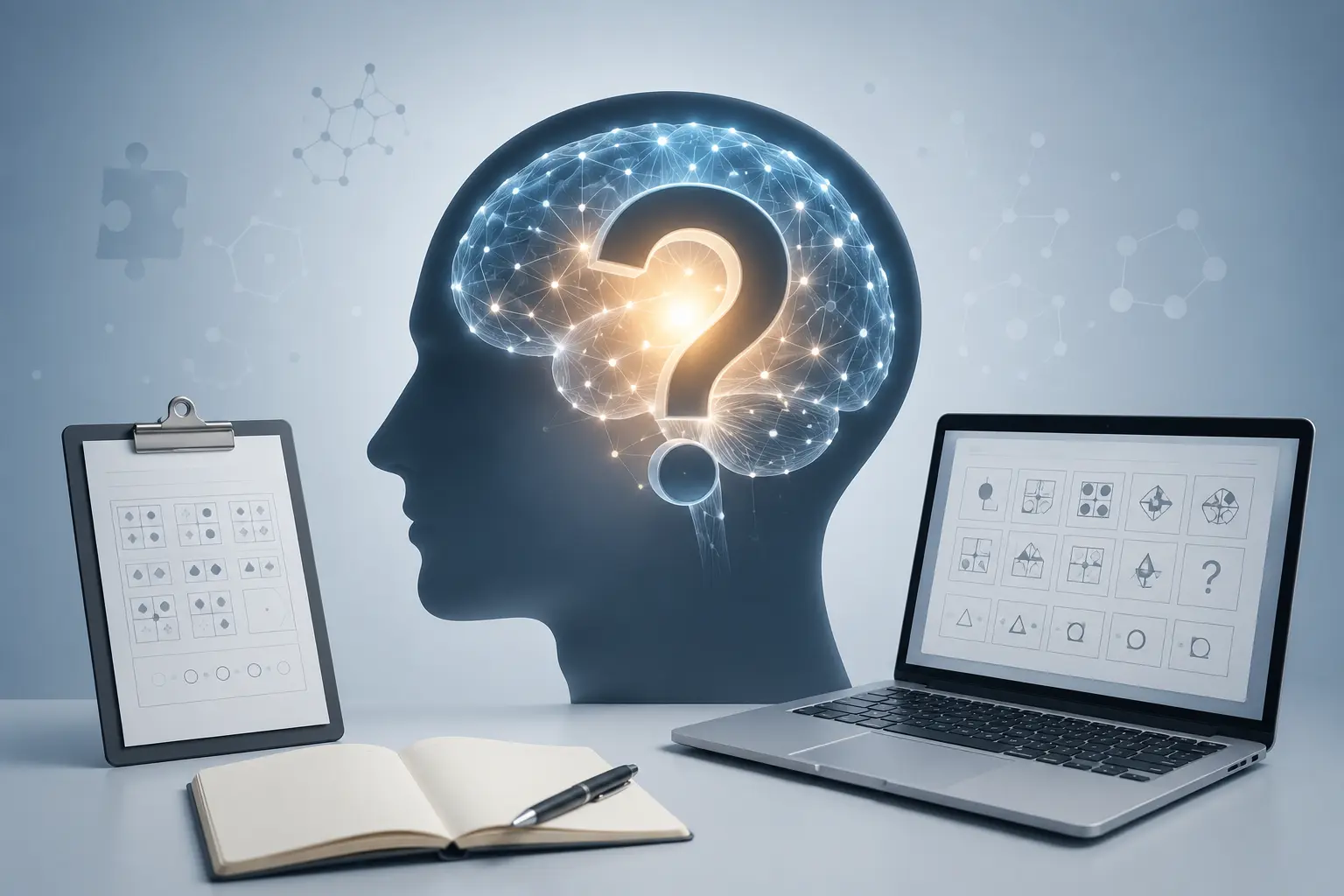
When you complete an online IQ test and see your score, your first thought is almost always: "Is this real, or just a random number?" That doubt is completely valid. While some online tests use sound methodologies, others exist purely for entertainment and lack any psychometric science. In this article, we explain what makes an IQ test reliable, how online tests compare to clinical evaluations, and how you should interpret your score.
"Reliability" and "Validity" Are Not the Same Thing
People often confuse these two concepts, but the distinction is critical:
- Reliability: How consistent a test is. If you take the same test a week apart, your score should stay largely the same.
- Validity: Whether a test actually measures what it claims to measure (intelligence) and aligns with established tests.
A test can be consistent but measure the wrong trait, or it can attempt to measure the right trait but deliver different results every time. A good test achieves both reliability and validity.
How Reliable Are Clinical IQ Tests?
Standardized tests used by psychologists are exceptionally reliable. The two most common tests, the WAIS (Wechsler Adult Intelligence Scale) and the Stanford-Binet, achieve internal consistency reliability scores between 0.96 and 0.98. In practice, if you retake the test after a few weeks, your score typically varies by only 5 to 10 points. Research also shows these tests correlate strongly with real-world outcomes like academic achievement, job performance, and occupational status.
What makes these tests valuable is that they are normed on sample populations of thousands of people. That means your score isn't an arbitrary number; it measures exactly where you stand relative to a broad population.
How Accurate Are Online IQ Tests?
Here, honesty is essential. Well-designed online tests can align with professional assessments by 75-85%. In fact, a 2024 study found that an online version of the WAIS yielded nearly identical results to the in-person version, with a correlation above 0.90. So calling all online tests "useless" is inaccurate.
However, the flip side is that most free internet tests publish no norming samples, reliability data, or evidence of validity. The scores generated by these tests are largely arbitrary. The issue isn't that a test is online, but whether a valid scientific methodology backs it up.
5 Factors That Make an Online IQ Test Reliable
You can determine whether a test is trustworthy by checking these criteria:
- Sufficient question volume: Tests with only 5–10 questions cannot provide reliable insight. An accurate estimate requires a broader pool of questions. (Our free IQ test consists of 28 questions.)
- Diverse cognitive domains: A good test does not rely on a single question type; it measures logic, memory, pattern recognition, and problem-solving together. We cover question types found in IQ tests in another article.
- Time tracking: Beyond correct answers, your completion speed acts as a key metric of cognitive processing speed.
- Consistent results: If you take the test again, your score shouldn't fluctuate wildly.
- Transparent scoring: The test should offer a clear IQ score range breakdown explaining what your result means.
The Flynn Effect: Why Is the Average IQ Always 100?
An interesting phenomenon: average IQ test scores worldwide rise by about 3 points every decade. Named after psychologist James Flynn, this is known as the "Flynn effect." Key drivers include improved nutrition, easier access to information, and familiarity with test formats. Because of this, IQ tests are re-normed periodically to reset the average score to 100. Scoring 100 does not reflect a fixed milestone; it simply means you fall exactly in the middle of current population standards. To learn more about standard score distributions globally and regionally, check out our article on average IQ scores.
Should You Take an Online IQ Test?
The short answer: yes, provided you set realistic expectations. A well-designed online test offers a strong estimate of your cognitive abilities, helps identify your strengths, and serves as an engaging way to track your development over time. However, no online test replaces a clinical evaluation by a licensed psychologist. If you require a formal diagnosis, educational placement, or a MENSA application, you need a proctored assessment. We cover where these evaluations take place in our article on where to take an official intelligence test.
In summary, reliability isn't determined by whether a test is online or offline, but by the methodology behind it. A test with enough questions, varied cognitive tasks, timed tracking, and clear scoring provides a realistic result. If you're curious about your score, take our free 28-question IQ test today, or read our guide on scientifically proven ways to boost your IQ.