
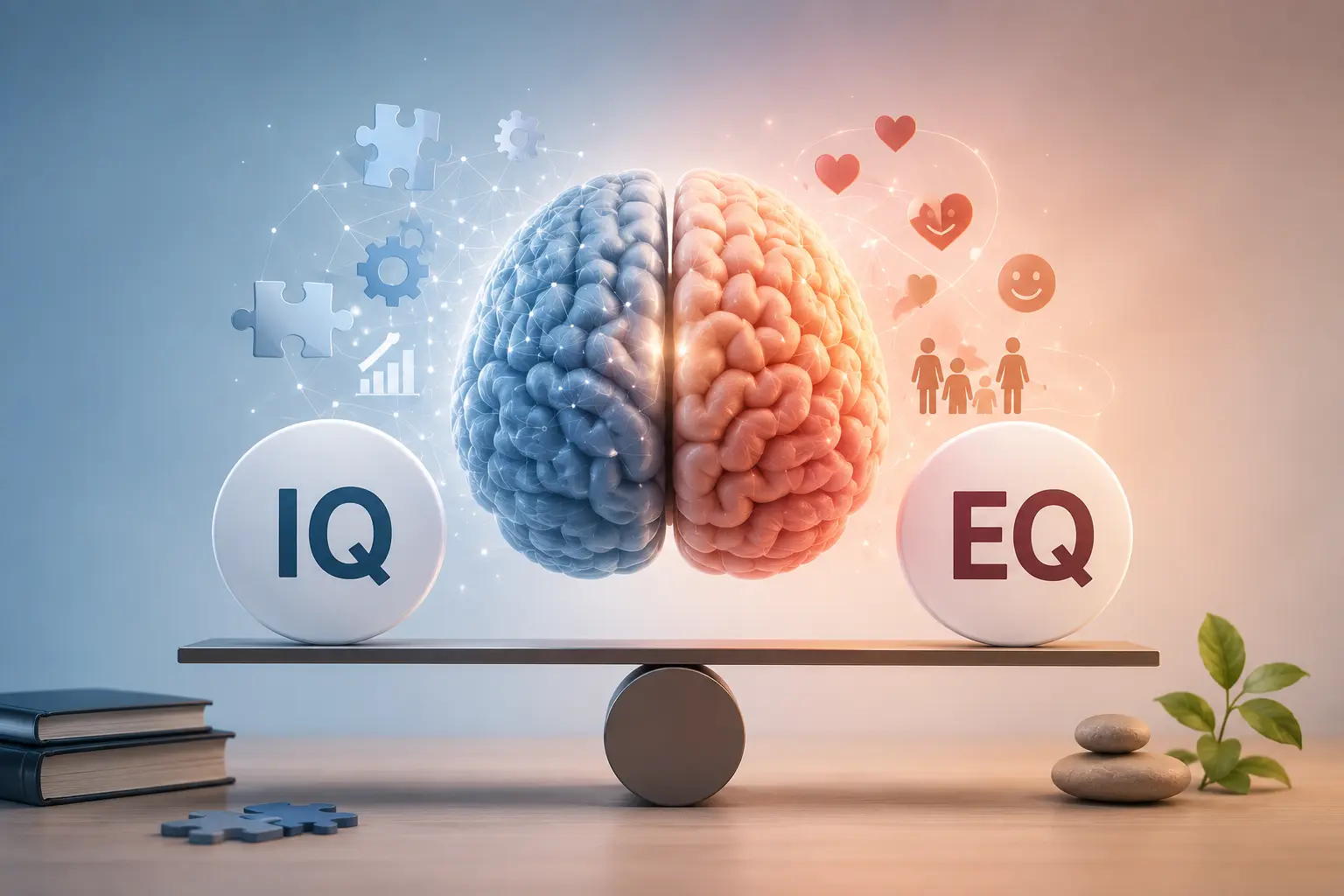
You have probably seen the smartest student in class have an average career, while a classmate with mediocre grades achieves great success. This is no coincidence. Logic and problem-solving speed, or IQ, are not the only measures of intelligence. Our ability to recognize and manage emotions often shapes our success more than IQ. We call this ability emotional intelligence, or EQ for short.
What is emotional intelligence (EQ)?
Emotional quotient (EQ) is your ability to recognize, understand, and manage your own emotions as well as those of others. The term gained global recognition in 1995 through psychologist Daniel Goleman's book of the same name. Goleman made a striking claim: success in life depends not just on how smart you are, but on how well you handle your emotions.
The 5 components of emotional intelligence
Goleman explains emotional intelligence through five core skills:
- Self-awareness: Recognizing and naming your mood and emotions in the moment. Asking yourself, "Why am I feeling tense right now?"
- Self-regulation: Controlling your impulses and thinking before you react. Like holding back from sending an angry message.
- Motivation: Pursuing goals with internal drive and perseverance, without needing external rewards.
- Empathy: Understanding how another person feels and acting accordingly.
- Social skills: Managing relationships, communicating effectively, and finding common ground with people.
The difference between IQ and EQ
They are not rivals; they are two different types of intelligence measuring distinct abilities:
| IQ (Cognitive Intelligence) | EQ (Emotional Intelligence) |
|---|---|
| Logic, analysis, problem-solving speed | Recognizing and managing emotions |
| Linked to exams and academic success | Linked to relationships and social success |
| Mostly genetic and fixed | Learnable and adaptable |
| Measured by a standardized test | Developed through behavior and habits |
If you are curious about your cognitive intelligence level, you can measure it with our free 28-question IQ test and read about common traits of high-IQ people in this article.
Why is EQ sometimes more important than IQ?
High IQ helps you solve a problem, but convincing a team to accept that solution, staying calm with a tough client, or resolving a conflict without drama is entirely up to your emotional intelligence. Research shows that technical skills only get you so far, while those who can manage their emotions truly make a difference. People with high EQ generally experience less stress, communicate better, and bounce back from challenges more easily. That is why EQ is often more decisive than IQ, especially in leadership and teamwork roles.
Can you develop your emotional intelligence?
Here is the good news. While IQ is largely determined by genetics, emotional intelligence is like a muscle that grows with practice. Goleman also emphasizes that EQ is not a fixed trait from birth, but a learnable skill. Here are a few simple habits to improve it:
- Try to notice how you feel throughout the day and why; naming an emotion is the first step to managing it.
- Pause for a few seconds before reacting; act out of choice, not impulse.
- Listen to others attentively to understand them, not just to prepare your answer.
- Try to understand feedback before getting defensive.
So, which one matters more?
This is not a choice between IQ and EQ. IQ gets you through the door, but EQ helps you build relationships and manage opportunities once you are inside. The healthiest approach is to develop both: sharpen your cognitive skills with brain games and proven methods to boost your IQ, while practicing emotional awareness and self-management in daily life. Being smart is great, but combining intelligence with the right emotional skills is what sets you apart.