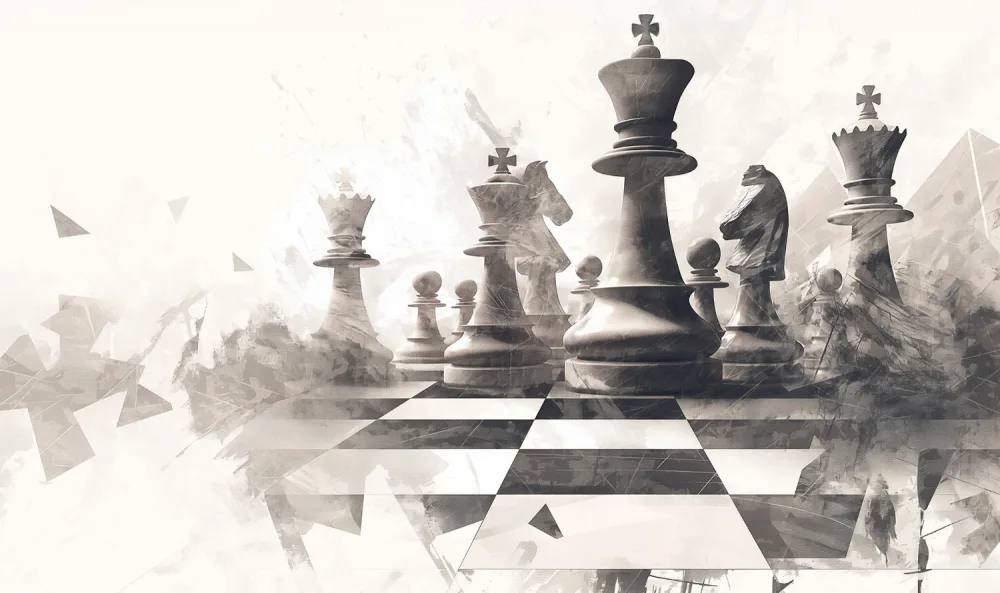
Chess holds a unique position as a cultural symbol of intelligence. Smart characters in movies play chess, calling a child "a chess player" is a compliment, and adding chess to school curricula is regularly debated.
The actual reality of this relationship is both more interesting and more limited than most people think.
The memory of masters: Legendary but conditional
The most striking trait of chess masters is their ability to look at a board for five seconds and recreate it almost perfectly. They recall the exact positions of over twenty pieces with an accuracy that beginners cannot come close to.
An experiment conducted in the 1970s made a simple tweak to understand this ability: they set up the pieces at random, rather than from a real game.
The result is one of the most instructive findings in chess literature. When faced with random setups, the masters lost their advantage almost completely, dropping close to the level of novices.
This shows that masters do not possess extraordinary visual memory. What they have is a vast vocabulary of tens of thousands of meaningful piece patterns. When looking at a real game position, they do not see twenty separate pieces; they see five or six familiar structures. This is called chunking.
This provides a fundamental lesson about expertise in general: expertise is not a stronger mind, but a better-organized knowledge structure. And by definition, it is domain-specific.
How strongly chess skill relates to intelligence
There is a relationship, but it is modest. Reviews generally report low-to-moderate correlations between chess skill and cognitive ability.
Two details put this picture into perspective:
- The link is clearer among beginner and intermediate players. It weakens at elite levels. One reason is range restriction: top players already come from a specific talent pool, so other variables explain the differences between them.
- Practice time is the single strongest predictor. Deliberate practice accounts for roughly a quarter of the variance in chess performance—the highest share among studied fields. We cover this in detail in our article on the 10,000-hour rule.
In short, high intelligence makes it easier to progress in chess, but mastery is largely determined by an accumulated mental library of patterns.
The real question: Does playing chess increase intelligence?
Up to this point, we have looked at the traits of people who are good at chess. A far more important question is: Does learning chess improve skills outside of chess?
This is the question of far transfer, and it is where cognitive science encounters the most misconceptions.
What studies in schools found
Numerous studies have examined the impact of chess instruction on math performance and general cognitive skills. At first glance, results appear positive.
However, reviews that sort these studies by quality find a consistent pattern: the better designed the control group, the smaller the effect size.
If you compare children taking chess lessons with children doing no extra activities, you find a difference. But when you compare the chess group with a group doing another structured activity for the same amount of time (such as checkers, music, or extra math), the difference largely disappears.
This shows that what is being measured is not specific to chess: engaging regularly in a structured mental activity with an adult helps; it does not have to be chess.
Expectation and selection bias
There are two additional issues. First, children enrolled in chess courses are not selected at random—they come from interested, supportive families. Second, because everyone believes chess boosts intelligence, both teachers and students develop expectations.
This same methodological trap exists in brain-training apps, as we explained in our article on whether brain games actually improve your brain.
So what is the point of playing chess?
Even if the transfer claim is weak, chess teaches valuable skills in its own right. There is no need to squeeze them into an unprovable promise like "it boosts your IQ":
- Accepting outcomes. When you lose, there are no teammates, referees, or luck to blame. That is a rare and valuable lesson for children.
- Thinking ahead. Considering the consequences before making a move is the core discipline chess enforces.
- Sustained concentration. Finishing a full game is great practice in an era where undivided attention is increasingly rare.
- Concrete progress feedback. The rating system makes improvement visible—an ideal condition for deliberate practice.
- Accessibility. It is inexpensive, playable at any age, and requires no physical setup.
Should you teach your child chess?
To boost their math grades: there is no solid evidence supporting this; spending that time directly on math is far more effective.
To help them gain a challenging, structured, and enjoyable hobby: it is a great choice—just like a musical instrument or another strategy game. Setting the right expectations preserves the joy your child gets from the game.
If you are curious about similar problem-solving skills, check out our articles on how to solve logic puzzles and Tower of Hanoi. If you want to evaluate your own reasoning performance, take our free IQ test.