
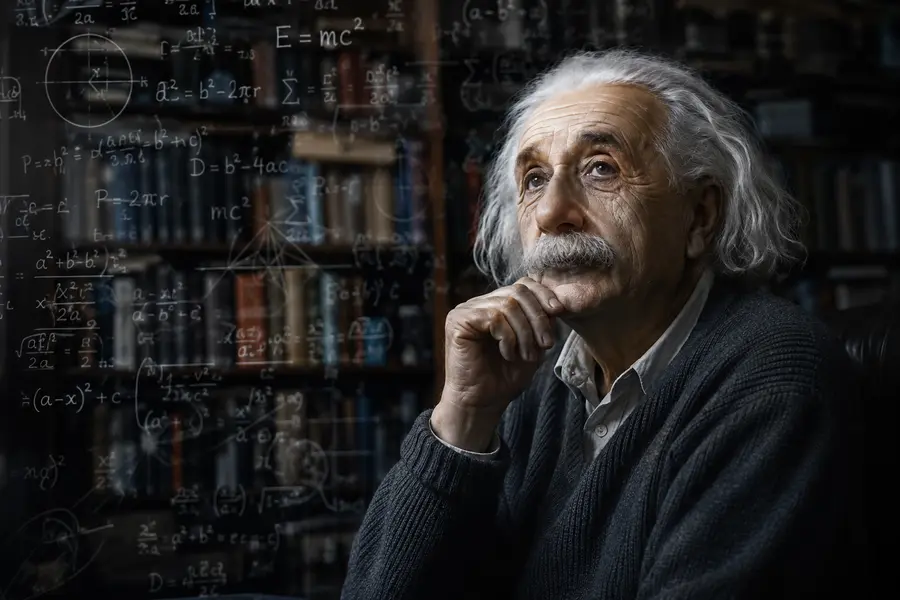
We use the word "genius" all the time in daily life: for a kid winning chess games back-to-back, a groundbreaking engineering fix, or even a clever joke. But what does science consider a genius? Is anyone above a certain IQ score automatically a genius, or is true genius something else entirely? In this article, we look at where the numbers come from and what they leave out.
Is there an official IQ threshold for genius?
The short answer: not today, but there used to be. In 1916, psychologist Lewis Terman developed the Stanford-Binet test and labeled scores of 140 and above as "genius or near genius." The popular idea that "140+ means genius" comes straight from this century-old chart. Modern psychology has long retired the "genius" label. In current classifications, scores above 130 are listed as "very superior" on the IQ score table. Psychologists today won't give you an official "genius" report; they classify high cognitive ability instead.
To see how rare these scores are, look at the bell curve distribution with an average IQ of 100. Scores above 130 appear in about 2% of the population, while scores above 145 occur in roughly 1 in 1,000 people. MENSA, the world's best-known high-IQ society, uses this top 2% threshold for membership.
What were the IQ scores of famous historical figures?
Interestingly, most famous figures considered geniuses never took an IQ test. The claimed "160 IQ" for Albert Einstein is purely an estimate; he never took a test in his life. We covered this topic in detail in our article on Einstein's IQ score. Among documented scores, there are surprising examples: Nobel Prize-winning physicist Richard Feynman reportedly scored around 125 in high school. This score—brilliant, but below the old "genius threshold"—is a favorite example of how a single number fails to predict what someone can achieve.
Terman's geniuses: A century-long natural experiment
The best study showing what a high IQ does—and doesn't—guarantee also comes from Terman. In 1921, he selected roughly 1,500 children in California with IQs over 135 and tracked them for decades. Nicknamed the "Termites," these children grew up to earn above-average incomes and achieve high educational and career success, but not one won a Nobel Prize. Even more striking: two children rejected from the study for falling below the threshold, William Shockley and Luis Alvarez, later won Nobel Prizes in physics. History's most extensive "genius hunt" had screened out two actual geniuses because of a test cut-off.
Why genius is more than just IQ
Many researchers support the "threshold hypothesis": up to a certain point, IQ correlates with creative achievement, but beyond that level, the connection weakens. Above the threshold, other variables take over: creativity, curiosity, long-term grit, and the luck of working on the right problem at the right time. What we call genius usually stems from high cognitive capacity combined with thousands of hours of intense effort and passion. As explained in our guide on what intelligence is, intelligence isn't a single number, and genius is a rare combination of these distinct traits.
The same principle applies to parents who notice early signs in their child: early reading or a strong memory alone do not mean genius. We gathered signs and action steps in our guide on is my child gifted.
Curious about your own score?
The genius label may be scientifically retired, but exploring your cognitive abilities is completely natural. You can evaluate your profile in about 15 minutes with our free IQ test, which measures logic, visual analysis, memory, and verbal comprehension. No registration is required, and your results appear instantly. The score doesn't define you, but it shows where you start—and as Feynman proved, what you build matters far more than a number.