
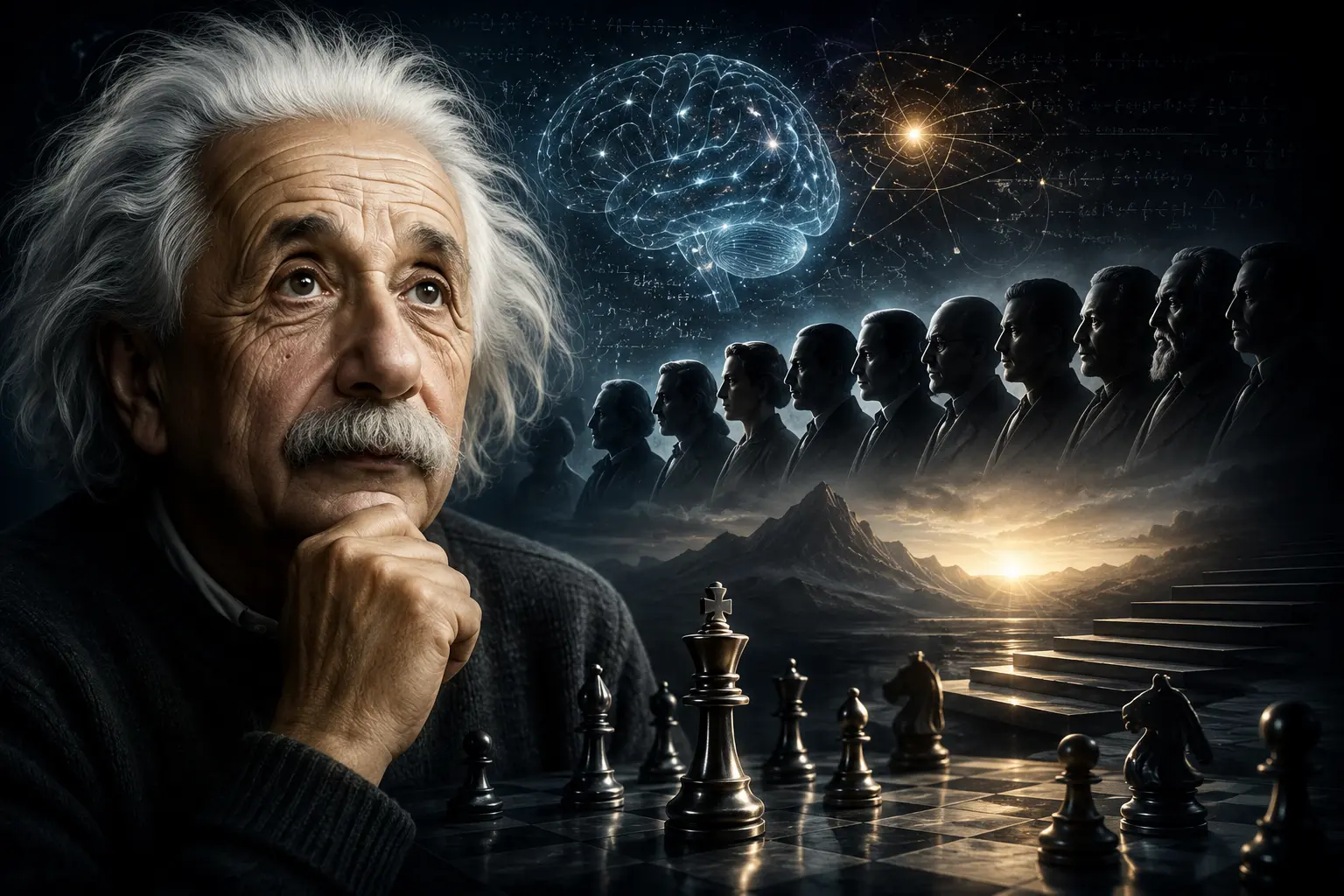
“How high was Einstein’s IQ?” is one of the first questions that comes up when people talk about intelligence. Online, you often see numbers like 160 or even 190. But are those numbers real, or just a myth? In this article, we look at Einstein’s real story and the names said to have the highest IQs in history, without exaggeration.
What Was Einstein’s IQ, Really?
Here’s the most surprising part: Albert Einstein never took an IQ test in his life. So the “160 IQ” figure often mentioned for him is not a measurement, but a later estimate. These estimates are usually based on the difficulty and impact of his work.
So Einstein’s genius is beyond dispute, but the exact IQ score often attached to him is not a scientific fact. It is a number created by popular culture. The same is true for many of the historical names on this list.
10 Names Said to Have the Highest IQ in History (Estimated)
In the table below, you can find the names often mentioned and the estimated IQ values attributed to them. Since the scores of historical figures are retrospective estimates, they are not exact.
| Name | Estimated IQ | Known For |
|---|---|---|
| William James Sidis | 250–300 (unverified) | Child prodigy, mathematician |
| Terence Tao | ~225 | One of the greatest mathematicians of our time |
| Christopher Hirata | ~225 | Astrophysicist, NASA at a young age |
| Kim Ung-Yong | ~210 | Korean child prodigy |
| Leonardo da Vinci | ~180–190 (estimate) | Painter, inventor, polymath |
| Isaac Newton | ~190 (estimate) | Physicist, mathematician |
| Marilyn vos Savant | ~190 | Former Guinness record holder |
| Garry Kasparov | ~190 (estimate) | World chess champion |
| Albert Einstein | ~160 (estimate) | Theory of relativity |
| Stephen Hawking | ~160 (estimate) | Theoretical physicist |
One Note: Hawking and “Bragging About IQ”
Here’s an interesting detail: when Stephen Hawking was asked about his IQ, he refused to give his score and said, “People who boast about their IQ are losers.” It’s a reminder that high intelligence is not just a number.
Why Should You Treat “Highest IQ” Numbers With Skepticism?
Most of the numbers in these lists are not certain for three reasons:
- Historical estimates: Names like da Vinci or Newton never took a test; their scores were estimated centuries later.
- Scale limits: Modern IQ tests usually cannot measure reliably above 160; numbers like 250 lose statistical meaning.
- Mythmaking: Numbers like William James Sidis’s “300 IQ” are not documented measurements, but exaggerated rumors.
In short: it’s best to see these numbers as interesting curiosities, not as “definite facts.” For a better sense of what intelligence really means, you can check our articles on what the average IQ is and the IQ levels chart.
So, What Is Your IQ?
Reading about history’s geniuses is inspiring, but what people usually want to know is their own level. With our free test, no registration required, you can get an idea in just a few minutes.
Conclusion
Einstein’s IQ was never actually measured; the numbers attributed to him and other geniuses are mostly estimates. These lists are fun to explore, but intelligence is too broad to fit into a single number. What matters is keeping your brain active and developing it regularly.