
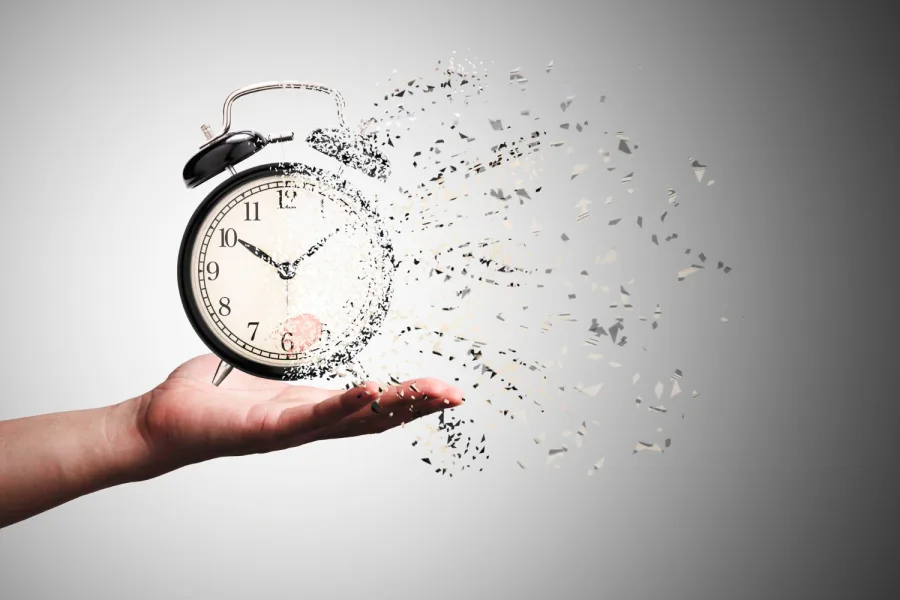
When you were a child, summer break seemed endless. School was months away, and those months felt genuinely long.
Now, half the year is already gone, and you barely remember how it passed.
Almost everyone experiences this, yet few question why. The explanation is surprisingly simple: time is not speeding up, your memories are just becoming sparser.
First, a distinction: which type of time?
Time perception is not a single process. We are dealing with at least two distinct mechanisms, and they can work in opposite directions.
- Prospective (real-time) time: How you perceive time in the moment. During a boring meeting, time drags on slowly.
- Retrospective time: How long a past period feels after it has happened. When you look back on that boring meeting later, it feels brief.
These two systems function in opposite ways, explaining both the holiday paradox and the effect of aging on time.
Prospective time: the role of attention
How you perceive duration in the moment depends on how much attention you pay to time itself. When you are bored and have nothing else to engage with, you monitor time, making it feel painfully slow.
When you are deeply absorbed in a task, your attention is fully focused on what you are doing. With no mental resources left to track time, hours vanish. This is a defining feature of the flow state.
Retrospective time: memory density
You estimate the duration of a past period by counting how many memories you retained from it. The mind does not keep a stopwatch; it counts markers.
A week filled with rich, novel experiences feels long in retrospect. In contrast, a month where every day looks identical collapses into a single memory block, making it feel very short.
Two explanations for the age effect
The proportional theory
This classic explanation dates back to the 19th century. The concept is straightforward: each passing year represents a smaller fraction of your total life so far.
For a five-year-old child, one year is a fifth of their entire life. For a fifty-year-old, it is only one-fiftieth. Relative to your total lived experience, the same calendar interval feels progressively smaller.
While elegant, this theory is insufficient on its own. It does not explain why our brains would measure time proportionally, nor does it account for certain real-world observations—such as why some periods in old age can feel long again.
Novelty and memory density
This is widely considered the more compelling explanation.
Childhood and youth are filled with firsts: your first day of school, first trip, first close friend, first failure. Each new experience gets encoded as a distinct memory because it does not fit any existing mental template.
In adulthood, routine takes over. You commute along the same route, work the same job, visit the same places. Your brain stops saving repetitive experiences as separate files and simply overwrites existing patterns. As a result, a full year passes, but very few distinct memories remain when you look back.
This makes the year seem short. It wasn't the year that was short, but the trace it left behind.
Putting both together
These two mechanisms are not mutually exclusive and likely both play a role. However, the memory density theory has a key advantage: it produces a testable prediction.
The prediction is this: regardless of age, any period packed with intense and novel experiences will feel long in retrospect. Research confirms this. Your first month living abroad is remembered as much longer than an ordinary month in your hometown.
The holiday paradox
The clearest demonstration of these two time systems occurs on vacation:
- While on vacation, days fly by fast because your attention is engaged and you aren't monitoring time.
- Once the vacation ends, it feels like you were away for a very long time because you accumulated many new memory markers.
The same event yields opposite results across the two time systems. A routine week produces the exact reverse: it drags while happening, but leaves almost no trace when you look back.
Other factors affecting time perception
- Emotional arousal. Moments of fear or danger are remembered as expanded. This is thought to happen because your brain records detailed information far more densely during threats; higher memory density makes the duration feel longer.
- Body temperature. As internal temperature rises, internal time tracking accelerates. This is one reason time seems to drag when you have a fever.
- Attention and arousal levels. Stimulants and high arousal shift time estimation toward feeling longer.
- Age and cognitive speed. A slowdown in cognitive processing speed may reduce the amount of information processed per unit of time. We explored this slowing effect in our article on fluid and crystallized intelligence.
The only known way to slow down time
If this theory is correct, the practical takeaway is simple: increase the number of memory markers.
Here are actionable ways to do that:
- Break your routine. Take a different route home, eat somewhere new, or walk through an unfamiliar neighborhood. Even small changes generate distinct memory markers.
- Learn a new skill. Learning is, by definition, a series of non-repetitive experiences. It also benefits neuroplasticity.
- Explore unfamiliar places. Memory density from travel depends on novelty, not distance. Visiting a neighborhood in your own city that you have never been to works just as well.
- Pay attention to the present. Experiences lived on autopilot are rarely encoded. Engaging with mindful awareness helps record the same experience. Our article on meditation and attention explores this topic further.
- Write things down. Journaling works on two levels: you process experiences while writing, and you create a record to look back on. A year that felt empty often reveals itself to be full when reviewed in a journal.
- Beware the photography trap. Constantly snapping photos can externalize the experience instead of internalizing it—an everyday example of cognitive offloading. Research suggests we often remember less about objects or scenes we photograph.
Another way to look at it
This subject is often discussed as a story of loss: time is slipping away, and we must do something about it.
Yet there is another interpretation. Routine failing to generate new memories is an efficiency feature, not a flaw. By not recording repeated experiences over and over, your brain conserves cognitive resources, freeing up room for what is truly new and important.
Saying "I don't know where the year went" does not necessarily mean your year was wasted. It might simply mean it was stable, predictable, and free of crisis—which is often a good thing.
Still, striking a conscious balance is worth the effort. A completely predictable life leaves behind a very thin year in your memory.
Frequently asked questions
Do children really perceive time differently?
Research shows that children perform differently from adults on time-estimation tasks. In addition, the sheer density of novel experiences in childhood directly increases the retrospective sense of duration.
Does boredom actually slow down time?
In prospective perception, yes. But retrospectively, boring periods are remembered as short. The two systems operate in opposition.
Is this a memory problem?
No. Not recording routine activities as separate memory files is normal brain function. However, an inability to recall recent events is a different issue and should be evaluated—see our article on aging and cognitive protection.
Can time perception be measured?
In laboratory settings, it is measured using duration-estimation tasks. In daily life, the simplest way is to count how many distinct memories you can recall from a given period. If you want to check your general cognitive performance, try our free IQ test.