
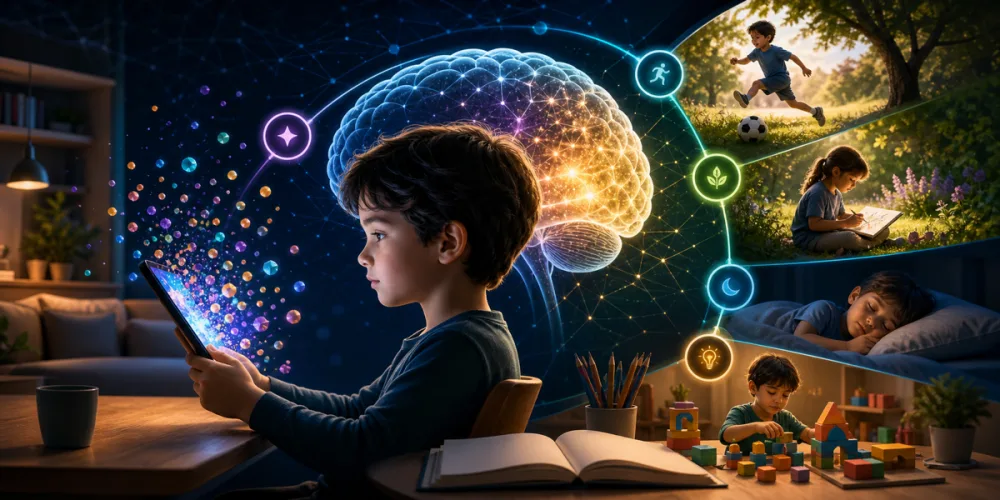
A toddler calming down with a tablet, a teenager unable to look away from short videos... Screens are in every corner of our lives and have become a major concern for parents. "Does screen time harm my child's brain, ruin their attention, or affect their intelligence?" The answer is neither a total disaster scenario nor entirely harmless. The truth lies in between and in the details.
Is It Time or Content?
This is the most overlooked point in screen debates. "What they watch and do" is just as important as "how many hours"—if not more so. Whether a child spends screen time passively watching fast videos or creating something in an app makes a big difference. The exact same hour can enrich or dull a mind, depending on the content. Judging screen use as a single, uniform activity is misleading from the start.
How Fast Content Affects Attention
The real concern lies with fast-paced content that changes scenes every second and offers constant stimulation. When the brain gets used to continuous, effortless stimulation, its tolerance for slow-paced, effortful tasks—like reading a book or doing homework—can drop. This is not permanent "damage," but a matter of habit: the brain expects whatever pace it gets used to. Constant stimulation can make patience and deep focus harder.
The Impact on Sleep
Perhaps the most concrete and least debated effect of screens is on sleep. The light emitted by screens and the stimulating nature of content make falling asleep harder, especially in the evening. Sleep is vital for a child's attention, memory, and general cognitive development. So, even if indirectly, screen time can negatively affect focus and learning by disrupting sleep. That is why pre-bedtime screen use needs the most care.
Very Young Ages
For infants and toddlers, the picture is clearer. At this age, the brain develops best through the real world, human faces, and physical interaction. When screens replace these valuable real-world experiences, a loss occurs. Limiting screen time for young children is not about enforcing a ban; it ensures they get the real interactions they need to grow. The replacement effect is key here.
The Positive Side of Screens
On the other hand, demonizing screens entirely is unrealistic. Well-designed educational content, creative apps, or documentaries watched and discussed together can genuinely add value. A video call with a distant grandparent is also screen time, but it is enriching. The goal is not to eliminate screens, but to use them mindfully and selectively. Right content in the right amount is valuable as a tool.
Finding the Balance
A healthy approach turns screen time into just one option among many, not life's sole entertainment. A child who plays, reads books, spends time outdoors, and has the chance to get bored will build a more balanced relationship with screens. Surprisingly, boredom itself is valuable: it sparks a child's own play and imagination. Filling their environment with rich options works much better than total bans.
Leading by Example
Finally, children learn from what they see, not what they are told. A parent constantly staring at their phone won't get far saying "put your screen away." Family time without screens and playful moments spent together send a stronger message than any rule. A healthy relationship with screens starts with household habits. A child's balance is often shaped by the family's own balance.
Age-Tailored Approaches
The right dose of screen time doesn't fit into a single rule; it changes with age. While real interaction must be almost the sole priority at a very young age, selective and balanced screen use can become a natural part of life as children grow. For a school-age child, it is not about removing screens, but balancing them with homework, play, sleep, and social life. The answer to "how many hours" differs for a baby, an elementary student, and a teenager. Each stage requires its own measure.
If you want to make screen time more meaningful, our mind games that exercise focus and thinking can be a great alternative.