
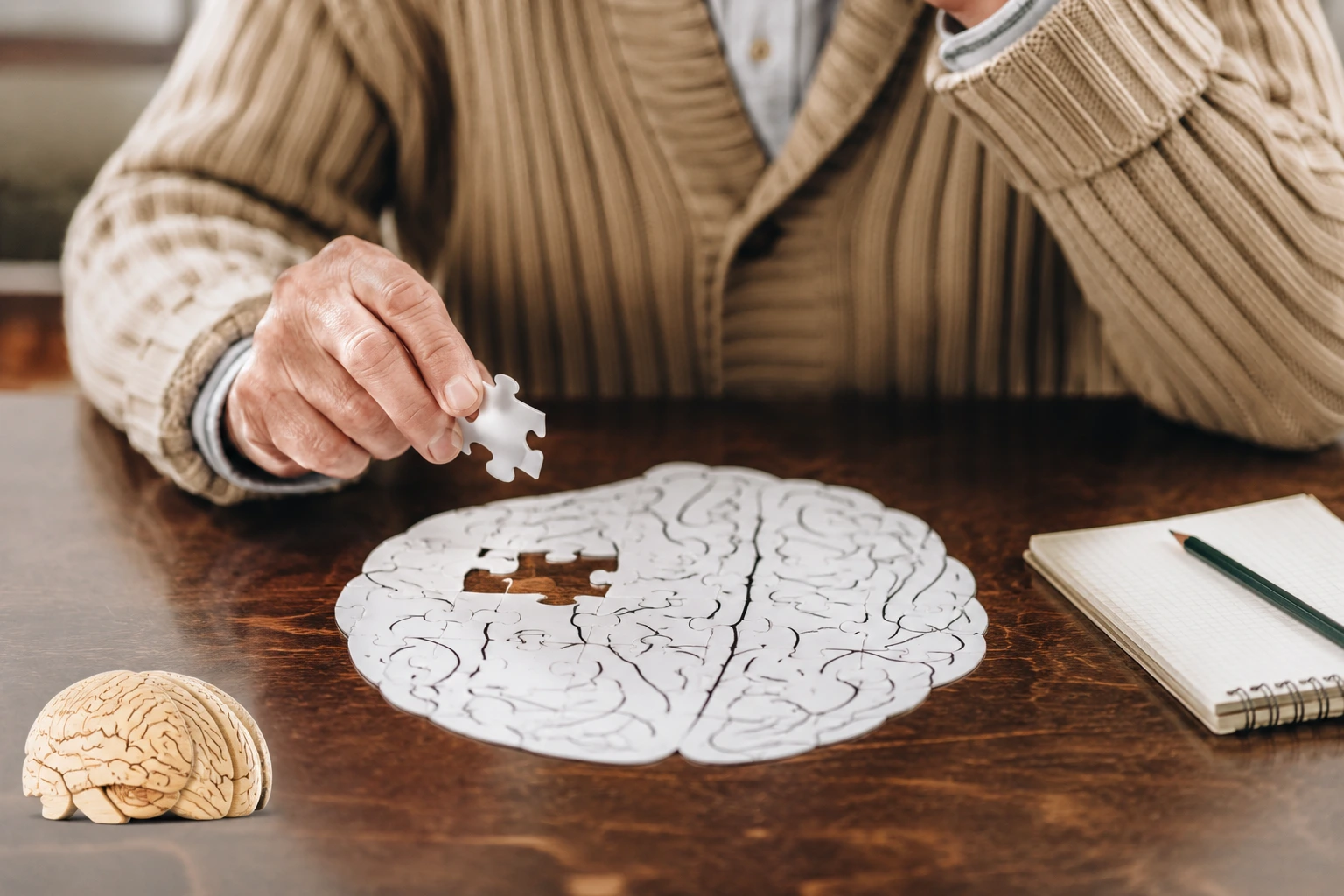
That moment when you’re holding your keys and thinking, “Where are my keys?” Or the frustrating time when a familiar name sits right on the tip of your tongue and still won’t come out. We all go through it, and most of us quietly wonder, “Is my memory getting worse?” I have good news: forgetting is often not a flaw. It’s part of how the brain is built. Even better, forgetting follows a pattern. And once you know the pattern, you can deal with it. Let’s look at the science of forgetting first, then talk about the exercises that really help.
Forgetting is not a character flaw, it is biology
The first person to prove this was German psychologist Hermann Ebbinghaus, who experimented on himself in 1885. He memorized nonsense syllables and measured how much he could recall at different intervals. He found something surprising: most newly learned information slipped away in the first hours and days. This rapid loss is now known as the “forgetting curve.”
That may sound bad, but there is good news hidden in it: Ebbinghaus showed that this curve is predictable. In other words, forgetting is not random; it follows clear rules. And if you know the rules for something, you can turn them to your advantage. Forgetting is not completely bad, either: it is one way the brain clears out thousands of details that are not useful and makes room for what really matters.
Not everything declines with age
Here is a very reassuring fact that is not widely known. Psychologist Raymond Cattell divided intelligence into two parts: fluid intelligence (solving new problems quickly, processing speed) and crystallized intelligence (knowledge, vocabulary, and experience built over the years). Research shows that while fluid intelligence slows somewhat with age, crystallized intelligence is mostly preserved and may even increase.
So a 60-year-old may solve a puzzle more slowly than a 25-year-old, but they also have a much larger pool of knowledge and experience. That is why the idea that “we get dumber as we age” is wrong. The real picture is this: some abilities slow down, while others mature. And you can support both with the right exercises.
Techniques that really help with forgetfulness
Now let’s get to the most practical part. These are methods that have been known for centuries and are also backed by science:
1. Spaced repetition. This was one of Ebbinghaus’s most valuable findings: instead of cramming information all at once, review it at increasing intervals (one day later, three days later, one week later) to make it stick. Each review flattens the forgetting curve a little more.
2. Active recall. Instead of reading a text over and over, close it and ask yourself, “What do I remember?” Forcing your brain to retrieve the information strengthens it far more than passive reading.
3. Memory palace (the loci method). This technique goes back to Ancient Greece and Rome, where speakers used it to remember long speeches. It works like this: you mentally place the things you want to remember at specific points in a familiar location, such as your own home. Then you “walk” through that place and recall everything in order. That is still the secret of memory champions today.
4. Chunking. In 1956, psychologist George Miller suggested that short-term memory can hold about 7 items at once. That is why a long phone number becomes easier to remember when you break it into groups of three or four digits. Organizing information into meaningful chunks lightens the load on memory.
5. Association and visualization. When you connect new information to something you already know, or turn it into a vivid image, the brain catches it much more easily. To avoid forgetting a name, it helps to form a strange, memorable image linked to that person.
6. Attention first: Most “forgetting” is really information that was never stored properly in the first place. If you cannot remember where you put your keys, chances are your mind was on something else while you set them down. So the first rule is: give real attention to the moment you want to remember.
The real brain exercise: lifestyle
More powerful than any single technique is improving the environment your brain works in. The supports science agrees on most are:
- Physical exercise: Regular aerobic movement has been shown to support the hippocampus, the center of memory, and can even increase its volume in older adults. Even a brisk walk helps the brain.
- Sleep: Memory is strengthened largely during sleep. That is why pulling an all-nighter before an exam backfires: you forget more, and lack of sleep disrupts consolidation.
- Mental variety: Learning something new, reading books, and solving puzzles build a protective buffer called “cognitive reserve.” The brain stays alive when you use it.
- Social connection and stress management: Loneliness and chronic stress wear down memory; conversation, sharing, and calm nourish it.
Puzzles and memory games can also be a fun part of that variety. To be honest, a game mostly makes you better at that game; but keeping your mind busy, curious, and active is valuable in itself.
When is it normal, and when should you see a professional?
Most everyday forgetfulness is completely normal. But some signs may call for a doctor’s advice:
| Usually normal | Worth discussing with a professional |
|---|---|
| Forgetting where you put your keys | Getting lost in familiar places |
| Remembering a name later on | Asking the same question repeatedly in a short time |
| Walking into a room and forgetting why you went there | Growing more and more unable to handle daily tasks |
So forgetting from time to time is human; but if forgetfulness starts to disrupt your daily life or makes you worried, the best thing is to talk to a healthcare professional.
You can smooth out the forgetting curve with spaced repetition, strengthen memory with techniques like the memory palace, and give your brain the best conditions through good sleep and movement. If you want to exercise your mind in a fun way, the memory and attention games in our free brain games are a great place to start; if you are curious, you can also take a look at our IQ test. Remember: the real goal is not to never forget anything, but to keep your mind active and curious.