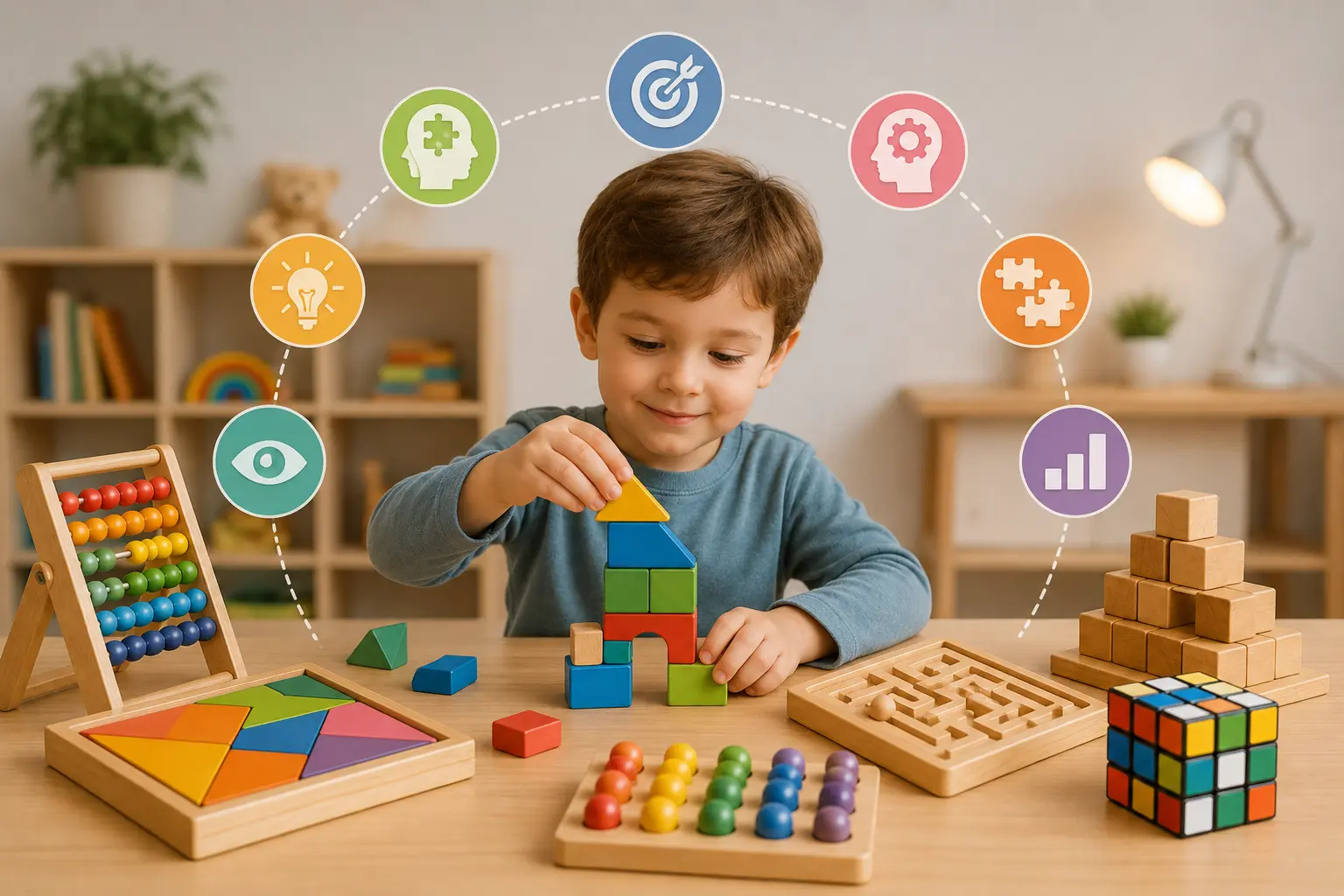
You may see your child working on a puzzle for minutes at a time and wonder, “Is this just a waste of time?” In fact, the opposite is true: at that moment, your child’s brain is literally working. Science clearly shows that play is not a luxury for children, but one of the cornerstones of development. In this article, I’ll explain in simple terms what brain games give children and which types are more suitable by age.
Play is “training” for a child’s brain
When children play, they challenge their minds without realizing it: they follow rules, wait their turn, make plans, and try again after making mistakes. These skills, which experts call “executive functions” — working memory, impulse control, and cognitive flexibility — form the basis of later school success, attention, and even emotional balance. As the American Academy of Pediatrics also emphasizes, play directly supports the brain’s structure and function; a child “learns how to learn.”
The good part is that children do this not because they have to, but because they enjoy it. They put in mental effort on their own terms, and that makes learning much more lasting.
What skills do brain games develop in children?
Research shows that well-designed games support development in these areas:
- Problem-solving: Facing an obstacle and trying different approaches strengthens the ability to find solutions.
- Memory (working memory): Holding information in mind and using it is the foundation for everything from math to reading.
- Attention and impulse control: Children learn to focus on one task and ignore distractions.
- Cognitive flexibility: They adapt quickly when rules change or they face a new situation.
- Numeracy and language skills: Math games improve processing speed, while word games expand vocabulary.
- Visual-spatial thinking: Puzzles and pattern games strengthen the ability to picture shapes in the mind.
In some studies, children who worked with attention and memory games also showed progress in school subjects like math. In other words, fun and learning often happen at the same time.
Best types of brain games for children
Every game trains a different skill. The table below summarizes which type of game develops what, along with examples from our site:
| Skill Developed | Game Type | Example |
|---|---|---|
| Memory | Matching / card games | Memory Cards |
| Attention | Spot-the-difference, observation games | Find the Differences |
| Logic & strategy | Puzzle, maze | Towers of Hanoi, Maze |
| Language & vocabulary | Word games | Word Puzzle, Hangman |
| Math | Fast calculation games | Fast Math |
Alongside these, classic rule-based games like “Simon Says” or “stop-go” also teach children to control impulses — and they do it without any screen at all.
How should you choose by age?
A child’s age should match the game’s difficulty. Executive functions develop especially fast during the preschool years, and working memory grows steadily from about ages 4 to 14. So:
- Preschool (ages 3-6): Simple matching, color and shape recognition, short memory games, and rule-based movement games are ideal.
- Elementary school (ages 7-10): Word puzzles, simple math games, mazes, and spot-the-difference games are just right.
- Older children (11+): Multi-step strategy and logic puzzles like the Towers of Hanoi challenge planning skills.
The general rule is this: the game should challenge the child a little, but not frustrate them. If it is too easy, they get bored. If it is too hard, they give up. A gentle challenge works best.
Digital or classic? Screen balance
Both board games and well-designed digital games can support a child’s development; what matters is the quality and length of play. A few practical tips:
- Keep the time reasonable; play should not replace sleep, physical activity, or socializing.
- If possible, play together from time to time — shared play strengthens both bonding and learning.
- Offer variety; instead of the same game over and over, choose games that touch different skills.
- Focus on trying and thinking, not winning. Making mistakes is completely normal.
Where should you start?
If you want to explore together with your child, you can take a look at our free brain games that do not require registration. From word puzzles to memory cards, from fast math to mazes, there are many child-friendly games that develop different skills. If older children are curious about their mental level, you can also look at our IQ test together as a fun starting point.
In the end, the goal is not to “make” a child a genius; it is to help them enjoy thinking, trying, and learning. The rest usually follows on its own.