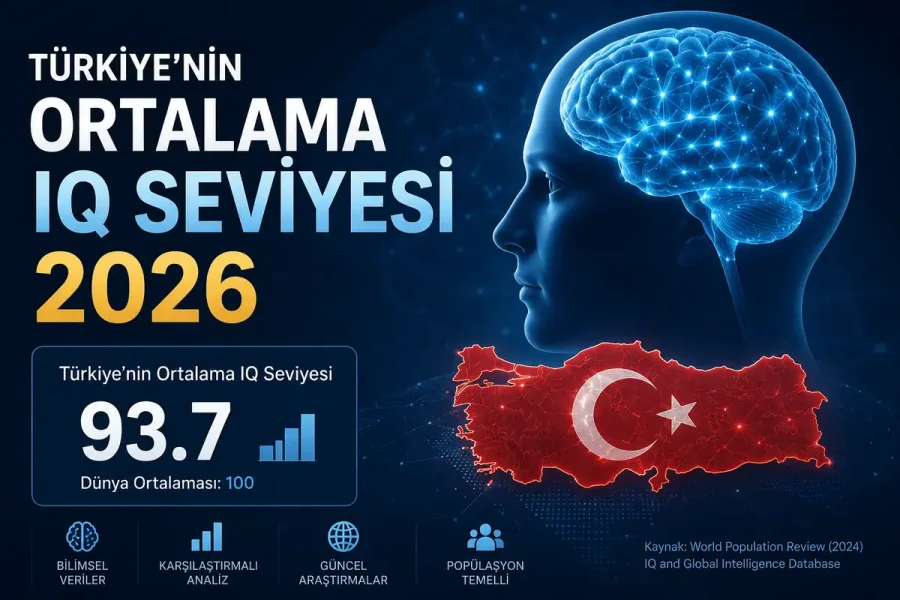
When you search for Turkey's average IQ online, you quickly find a clear answer: usually a number between 88 and 90, alongside a colorful world map. The main problem with this number isn't just that it is wrong — it is not based on actual measurement. No representative, nationwide IQ study has ever been conducted in Turkey. However, that does not mean we have no data at all. We just need to look in the right place.
IQ tests exist in Turkey, but no national average
Serious intelligence scales are used in clinical settings across Turkey. The WISC-R for children was adapted into Turkish by Savaşır and Şahin. Its standardization study was conducted with 1,639 children selected from 11 provincial centers, and the Turkish Psychological Association made it available in 1995. Reliability scores were high: .97 for the verbal section and .93 for performance.
Its successor, WISC-IV, had its Turkish rights acquired by the Turkish Psychological Association in 2008, with national norming and standardization completed in 2013. This means Turkey possesses an up-to-date child intelligence scale calibrated to its own norms.
Here comes a detail that many people miss: norming sets the average baseline at 100. When a scale is calibrated against a Turkish sample, Turkey's average becomes 100 by definition. So the answer to "What is Turkey's average IQ using Turkish norms?" is circularly 100.
This is not a flaw, but a natural result of how IQ testing works. IQ is not an absolute quantity; it is a relative position showing where someone stands within their age group. If you want to understand this logic in detail, you can read our article on how IQ scores are calculated.
The bottom line: WISC norms reliably tell you where a child stands relative to peers in their own country, but they are not designed for cross-country comparisons.
Where does that figure of 90 come from?
Country IQ maps circulating online rely almost entirely on a single source: the national IQ dataset compiled by Richard Lynn and Tatu Vanhanen. This dataset faced heavy criticism from scientific circles. Main objections include the lack of criteria for selecting studies, tiny and unrepresentative samples for some countries, estimates generated from neighboring countries where data was missing, and comparing fundamentally different tests.
So the number on that map is not the result of a measurement conducted in Turkey. We covered the details of this debate and why country rankings are misleading in our article on average IQ levels and IQ distribution worldwide and in Turkey. Now let's move to the key question: if there is no nationwide IQ measurement, what data do we actually have on Turkey's cognitive performance?
The real data we have: PISA
PISA is an international assessment conducted every three years by the OECD, measuring 15-year-old students in mathematics, reading, and science. Unlike country IQ tables, PISA uses representative samples, transparent methods, and administers the exact same test in every country. It is our most solid tool for comparing cross-national cognitive performance.
Here are Turkey's results in PISA 2022:
| Subject | Turkey | OECD average | Rank (81 countries) |
|---|---|---|---|
| Mathematics | 453 | 472 | 39th |
| Reading | 456 | 476 | 36th |
| Science | 476 | 485 | 34th |
Turkey scored below the OECD average in all three subjects. However, there is a detail not visible in this summary table: the average across all participating countries was 438 in math and 435 in reading. That means Turkey sits below the OECD average but above the global average. Depending on the benchmark you choose, the same result can be framed as "falling behind" or "ahead of the curve" — the most common manipulation in country rankings.
The real story is not the ranking, but the trajectory
When you look at the last decade rather than a single snapshot, the picture changes. The gap between Turkey and the OECD average in mathematics was 70 points in 2015; by 2022, it fell to 19 points. That represents a 51-point gain in just eight years.
In the OECD's own evaluation, Turkey is described as "one of the few countries that showed improvement in most domains over more than a decade in PISA." This pattern is rare in PISA history, where most countries either plateau or decline — especially during the 2022 cycle, when many OECD nations dropped sharply due to pandemic effects.
This upward curve connects directly to a key concept in IQ debates. The generational increase in test scores observed in developed countries during the 20th century, known as the Flynn effect, cannot be explained by genetics — better nutrition, healthcare, schooling rates, and cognitively demanding everyday environments drive this rise. Turkey's PISA trajectory suggests this exact process is unfolding right now in real time.
Does a PISA score equal IQ?
No, and maintaining this distinction matters. PISA measures how well learned knowledge and skills are applied through schooling; IQ tests target reasoning capacity largely independent of school curricula. You can study and prepare for one, but not so much for the other.
At the same time, studies repeatedly show a strong correlation between the two at the country level. The reason is straightforward: both rely on the same core competencies — reading comprehension, abstract reasoning, and efficient working memory usage.
Therefore, interpreting PISA as "Turkey's IQ" is incorrect. However, it is accurate to say it is our best indicator for answering: "Where is the cognitive performance of Turkish youth heading?" Moreover, it is a real measurement, not an invented estimate.
Why is a single number misleading?
Summarizing a nation with a single average hides internal disparities. One of the most consistent findings in PISA data is that student performance correlates strongly with socioeconomic background — and this link in Turkey is no weaker than the OECD average.
The gap between two students of the same age raised with different opportunities within the same country is often wider than the average difference between entire nations. Access to education, teacher quality, class size, books at home, family education level — all factor into measured performance. Saying "Turkey scored 453" compresses this entire distribution into a single point.
The situation is similar with IQ. Even when evaluating an individual's score, there is a margin of measurement error; in an abstraction like a national average, this uncertainty compounds exponentially.
What is the right question?
The honest answer to "What is Turkey's average IQ?" is we do not know, and current methods cannot tell us. No representative nationwide IQ study exists in Turkey. Even if one were conducted, cross-country comparisons would require different nations to take the exact same test under identical conditions, which has not happened.
A more constructive question is: Where is the cognitive performance of youth in Turkey heading over time? That question has an answer, and it is encouraging. Narrowing the gap with the OECD in math from 70 points to 19 points in eight years offers far more concrete insight than any questionable national IQ map ever could.
If you are curious about your own cognitive profile, instead of comparing yourself to a national average, you can take our free IQ test — the result shows where you stand within your peer group, which is what IQ actually measures. If you are considering an evaluation for your child, it is better to explore clinical methods described in our article on intelligence testing in children rather than online tests; scales like WISC-IV provide meaningful results only when administered by a trained specialist.